


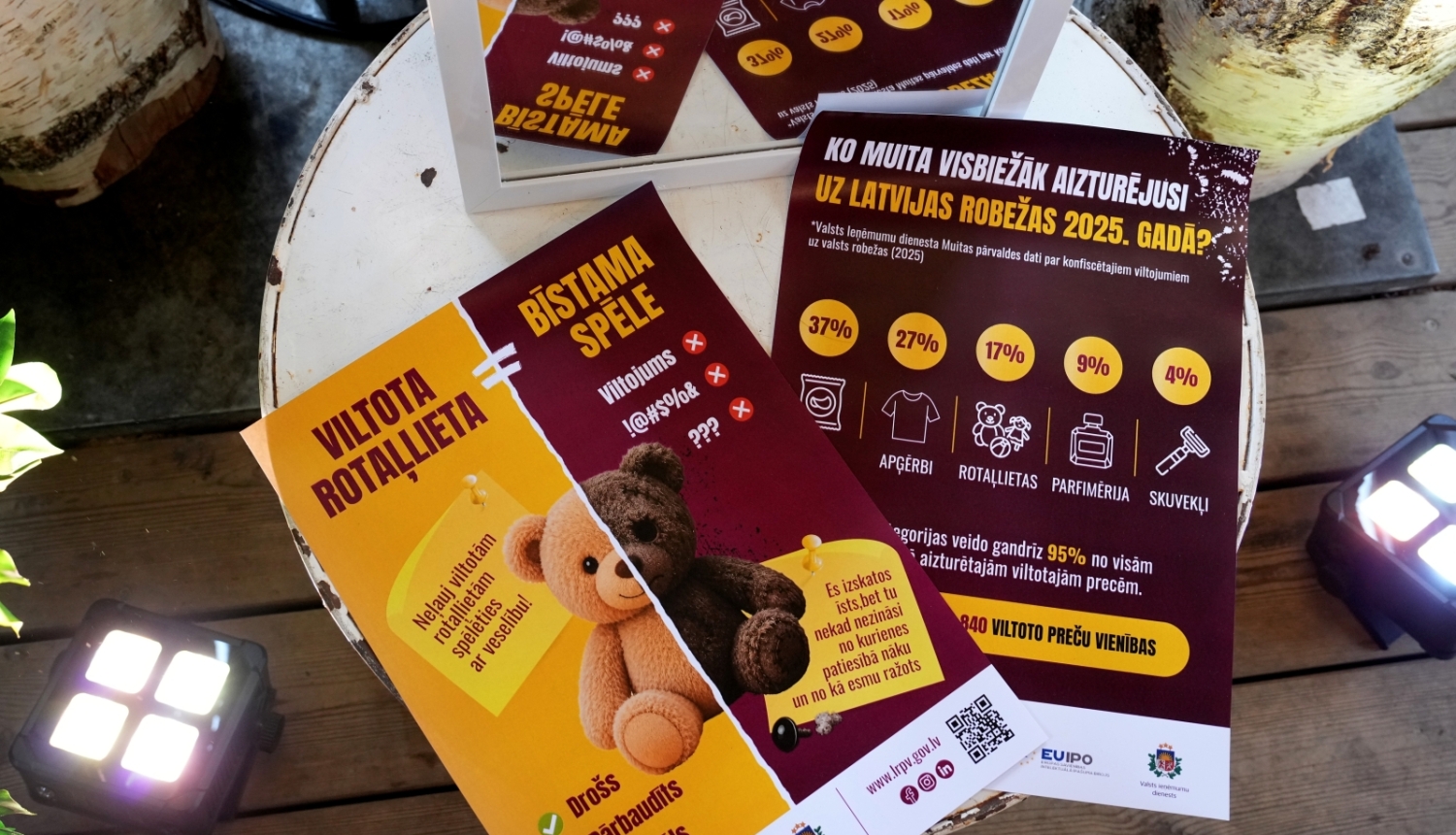
With talks on counterfeits, particularly the dangers of fake toys and their impact on health, and with creative workshops for children, the Patent Office launched the anti-counterfeiting campaign “Counterfeit Toys = Dangerous Play” on Thursday, 11 June, at Āgenskalns Market.
The aim of the campaign was to highlight an important issue—the risks counterfeit toys pose to children’s health and safety. Counterfeits often fail to meet European Union safety requirements, may contain harmful substances, or pose a risk of injury. Therefore, it is important to raise awareness among parents and children about safe and responsible toy choices.
During the event, visitors had the opportunity to learn about the dangers of counterfeits, how to recognise them, and what to do if a counterfeit product has been purchased.
“Nowadays, counterfeits are becoming increasingly difficult to recognise, and counterfeiters are putting more effort into convincing buyers that a product is original. The spread of counterfeit toys across Europe is a very pressing issue, and the fact that we do not see street vendors selling counterfeits in Latvia does not mean they do not exist—they do, and mostly in the digital environment,” said Agris Batalauskis, Director of the Patent Office.
Counterfeit toys are often closely linked to safety issues, and safety requirements for toys are particularly stringent, emphasised Linda Rinkule, Director of the Goods and Services Supervision Department and Deputy Director of the Consumer Rights Protection Centre. She urged: “Anyone who suspects they have come into possession of an unsafe toy should contact the Consumer Rights Protection Centre, as many of the complaints we receive provide valuable information for supervision. However, before buying, critically assess whether your child really needs such a toy. Having less but of higher quality is better than having more and potentially unsafe.”
Kristīne Beitika, content creator and mother of two, shared her experience with unsafe and potentially counterfeit toys: “I am worried about the consequences counterfeit toys can cause. That is why I prefer to buy quality toys, so that my children, my family, are safe. We need to speak more broadly about and draw attention to the risks such toys can pose. There are no “other people’s” children.”
Alongside the discussions, creative workshops were organised for young visitors, where they could make kites and assemble the Latvian-designed and patented felt construction set “Knop-Knop”.
Throughout the event, visitors could view an exhibition of counterfeit goods created from items confiscated by the Customs Board of the State Revenue Service and try to identify their features themselves, as well as ask questions to a customs officer. Perfumes, handbags, sports and fashion footwear, construction sets, and sports balls are just some of the items regularly seized at the national border. Among the confiscated goods are also more notable items, such as a children’s quad bike, which carries a number of very serious risks to health and even life.
Across the European Union, between 2020 and 2025, a jointly coordinated operation by Member States and institutions, “LUDUS”, aimed at eradicating the circulation of counterfeit toys, resulted in the seizure of 45.6 million counterfeit toys, with a total value of €149.7 million. Among the seized counterfeit goods, the most common items were card games, dolls, figurines, school accessories, and others.
In the European Union, the design, manufacture and sale of toys and games are regulated by strict standards. Individuals and organised groups involved in the production and distribution of counterfeit toys deliberately avoid complying with these requirements, even though they are developed to protect consumers’, especially children’s health and safety. The use of low-quality, toxic materials can cause severe and even life‑threatening injuries to children playing with counterfeit toys. Electronic toys pose additional risks, as their noise levels may exceed the regulatory limits, potentially causing irreversible hearing damage. Many toys rely on electrical components and other flammable materials, such as batteries, which may not meet applicable safety requirements.
Signs of a counterfeit may include spelling errors and the presence of multiple barcodes. Insufficient product information or inappropriate packaging can also serve as signs that help identify potentially counterfeit toys.
In 2025 the SRS Customs Board detained 23,840 units of counterfeit goods, with the largest product categories being crisps (37.29%), clothing (27.19%), toys (17.11%), perfumery (9.33%) and razors (4.03%). Among the seized counterfeit goods were also parts for mobile phones, bags and accessories, as well as stationery and packaging materials.