


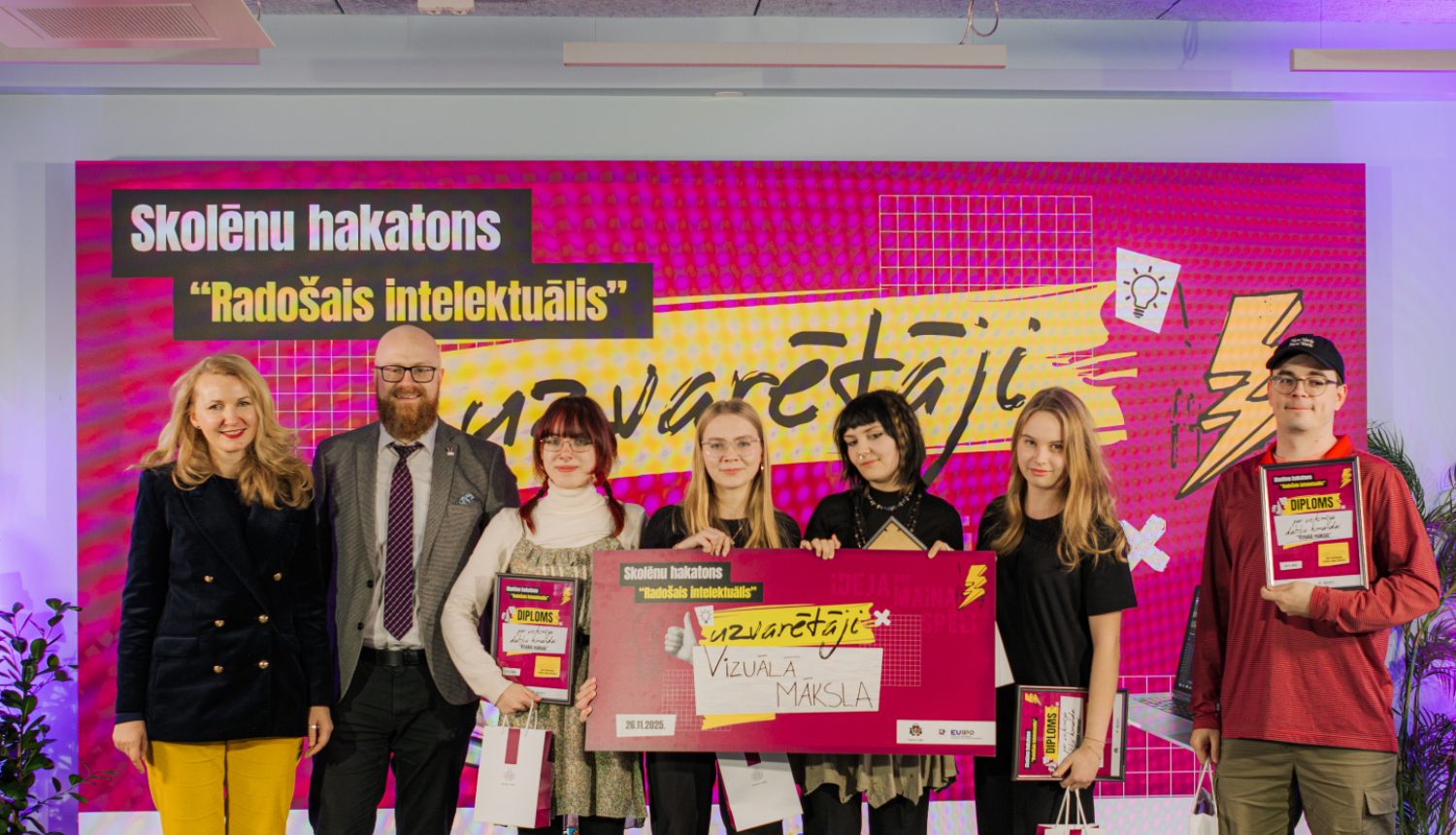
On Wednesday, 26 November, the first Creative Intellectual hackathon for schoolchildren organised by the Latvian Patent Office (LPO) took place at the Science and Innovation Centre of Riga Technical University, bringing together ten teams from different regions of Latvia. In a fierce competition, the main prize was won by the Vizuālā māksla (Visual Art) team from Riga School of Design and Art with the solution “Laika zagļi” (Time Thieves) - a board game prototype that helps young people identify habits formed by the digital environment, become aware of “stolen” time and create healthier daily routines.
The aim of the event was to promote creativity, raise awareness of the importance of intellectual property (IP) and encourage young people to create practical solutions to reduce digital stress, anxiety, and sleep deprivation. At the hackathon, teams had to develop a concept and at the end of the event present the solution, its creativity, innovation potential and IP approach. In order to better prepare for the event, teams received a task – a problem to be solved - in advance.
The main prize was won by the Vizuālā māksla (Visual Art) team from Riga School of Design and Art for the solution “Laika zagļi”(Time Thieves). The winning team developed the board game "Laika zagļi"(Time Thieves), which helps young people identify “bad” and “good” habits formed by the digital environment, understand how mobile phones, computers and social networks imperceptibly “steal” free time, and also promotes conversations and social interaction without screens. The game with a unique design, original illustrations and two categories of cards interactively teaches how to balance everyday life, strengthens healthy habits and is created with a clear IP strategy – from copyright to trademark and design protection.
Minister for Justice Inese Lībiņa-Egnere pointed out: “The hackathon has gathered creative and strong young people with solutions that connect the digital environment with real-life needs and help reduce stress, anxiety, and improve daily routines. Many of the solutions have the potential to become IP objects. May this event inspire the commercialisation of ideas and contribute to the Latvian economy, proving our ability to be creative and innovative. The size of the country does not matter – what matters is what we are able to create and how we are able to present ourselves to the world. Today I can see great ideas and the ability to implement them. Do not give if there is no immediate success and go on trying until you succeed, as this is the true spirit of entrepreneurs and innovators.”
LPO director Agris Batalauskis emphasized: “Today’s young people are active online, create content, experiment with technology and participate in business processes even at school. Therefore, it is so important to understand how the IP system works. A game-changing idea starts with the courage to think differently, the desire to create something new, and not to repeat what others have done, respect for one’s own work and also for others' contributions. This is a culture that we are creating together in schools, universities, and society as a whole.”
In addition, three sympathy awards were presented. The Latvian Performers’ and Producers’ Association (LaIPA) gave its prize to the RECOVER team; patent attorney Kristīne Viļķina awarded the Patentibus team; and the Latvian Design Centre presented the award to the Vizuālā māksla (Visual Art) team. The main award – an RD Electronics gift card worth 300 euros for each student in the team and an airBaltic gift card worth 200 euros for the teacher – was received by the winners of the competition.
The Vizuālā māksla (Visual Art) winning team members said: “We took part in the hackathon to strengthen teamwork and try something new. This was a way to explore different possibilities, apply knowledge in practice and do something interesting at the same time. We gained experience of collaborating with the teacher, being patient, repeatedly improving our solution, creating illustrations. We also have learned a lot about copyright and patenting. We plan to turn to Brain Games with our idea to understand how to develop it into a full-fledged product. We are also considering the possibility of participating in the Latvian Design Annual Award.”
A total of 41 teams – 205 students and 34 teachers from 34 educational institutions – applied for the hackathon. 10 teams were selected for in-person participation: Cepumiņi (Valka Jānis Cimze Gymnasium), Efektīvie (Riga Johann Steinhauer Secondary School), Intelektuālais piecītis (Jēkabpils Technology School), Izgudrotāju ciema komanda (Carnikava Secondary School), LORAKS (Druva Secondary School), Nova five (Cēsis State Gymnasium), Patentibus (Latgale Secondary School of Music and Art), RECOVER (Valmiera Pārgauja State Gymnasium), Vizionāri (Eleja Secondary School), Vizuālā māksla (Riga School of Design and Art).
Mentor support – from idea to presentation
At the hackathon, the teams worked under the guidance of experienced mentors. The young people's performance was evaluated by LPO director Agris Batalauskis; Dace Liberte, Chair of the Industrial Property Board of Appeal; Liena Edvardsa, CEO at LaIPA; Kristiāna Biezuma, a representative from Junior Achievement Latvia; Dita Danosa, Head of the Latvian Design Centre; Kristīne Viļķina, a patent attorney at VILKINA LAW; Luīze Mantiņa, a representative from Printful Latvia.
Dita Danosa, Head of the Latvian Design Centre, admitted: “We are all really pleased to see the enthusiasm, creativity and analytical skills of the participants. This is a powerful generation with great inner strength, determination and passion. It is doing – and not just intention – that allows us to become bigger and achieve more. We especially evaluated. The solutions that have chosen an unconventional approach and sought their own path are especially laudable. We hope that the participants will not stop with these solutions. If the ideas are implemented and supported, it will be a powerful contribution to both the future of young people and the development of Latvia.”